

If you want to live with your emotional support animal, you need to make that request with your landlord and also give them an ESA letter. You can do this in 4 steps:
Step 1: Call, text, or email your landlord to let them know you’re living with an ESA
The first step is simply giving your landlord a casual heads-up that you’re planning to submit ESA documentation. This is so that they’re not caught off guard and so they can anticipate receiving the documents from you.
Step 2: Make sure your ESA letter is in order
Verify that your ESA letter is on your healthcare provider’s letterhead, that it includes their contact and license info, and that it’s dated within the last year. The letter should also be signed by your therapist or doctor.
Step 3: Draft an email and send with attached ESA letter
The Department of Housing and Urban Development (HUD) advises that tenants keep a written record of the accommodation request, so spend some time drafting an email so you can keep a copy of your landlord’s response once you receive it. If you have a friendly relationship with your landlord, use that same tone in your writing. If you’re more distant, be more formal to maintain a level of respect. A formal email ensures that your request is clear and documented, providing you with a reference in case of any disputes.
Here’s an example of a draft:
Dear [Name of Landlord/Manager/HOA/Co-op]
I am writing to request accommodation of my emotional support animal pursuant to the Fair Housing Act and FHEO-2020-01 issued by the Department of Housing and Urban Development. I have attached a letter of recommendation (“ESA letter”) from my licensed healthcare professional as supporting documentation. I reserve all rights to confidentiality regarding specific details about my condition and medical history.
Please let me know if you have any questions about my request.
Thank you,
[Tenant’s name]
[Attached document]
Step 4: Follow up and document everything
After your initial email interaction, follow up with your landlord to confirm they have received and reviewed your documentation. Keep copies of all communications, including emails, letters, and meeting notes, for your records. Documentation is crucial if any disputes arise in the future. It also reinforces the legitimacy of your request and demonstrates your commitment to a transparent process.
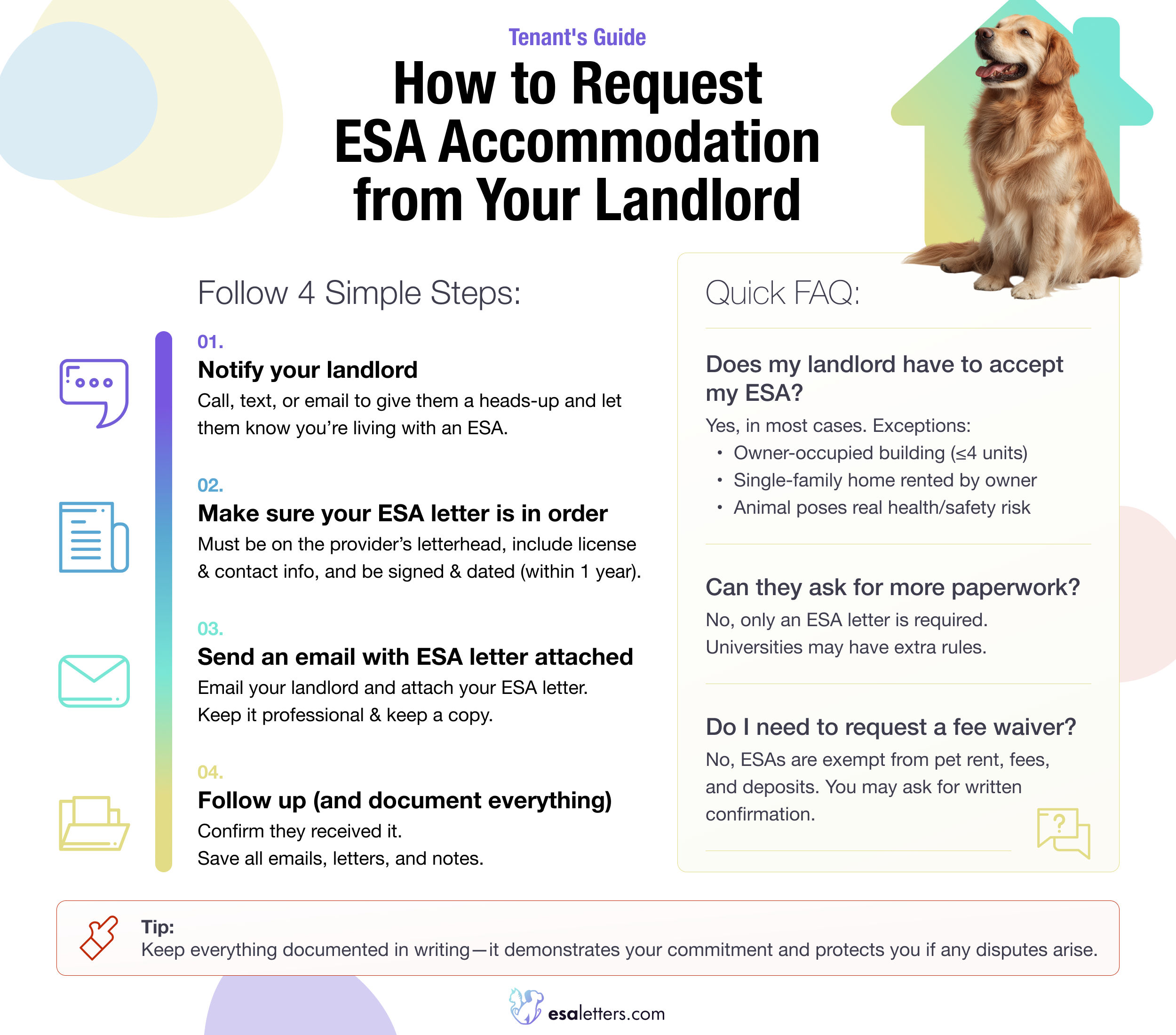
Does my landlord have to accept my ESA letter?
There are very few exceptions to federal housing rules under which a landlord can deny ESA accommodation requests. If you live in an owner-occupied building with no more than four units or a single-family home sold or rented by the owner without the use of an agent, your landlord does not have to accept your ESA letter. Additionally, if your animal poses a direct health or safety risk (in practice, not just theoretically), this could also be reason enough. In any case, you can always ask your landlord for ESA accommodation as a courtesy, even if they fall into this narrow category where they are exempt from the norm.
Can my landlord ask for additional documentation?
No, the only documentation a landlord can ask for is an ESA letter. Plus, they can’t ask you about your specific condition either. Keep in mind that you could still be asked to provide extra paperwork if you are in university housing. In that case, be sure to check your specific university’s policy. No matter the circumstance, legally, you cannot be charged an application fee for submitting your ESA documentation.
Do I ask for a fee waiver separately?
Once you’ve submitted your ESA accommodation documentation, you are legally exempt from pet rent, fees, and deposits. It’s always a good idea to get confirmation from your landlord in writing that they won’t be charging you these fees. In some cases, you might be able to get back pet rent or fees already paid, but there’s no clear guidance on this, and it’s more of a case-by-case (and landlord-by-landlord) basis.
 Get Started